

Clear thinking for busy operations.

Blogs & Guides
Articles and guides on labeling, scanning, and asset tracking.
FAQs
Short answers to common questions.
RFID
Simple insights about labeling and scanning.

FAQs
Everything You Need to Know About Barcode Labels
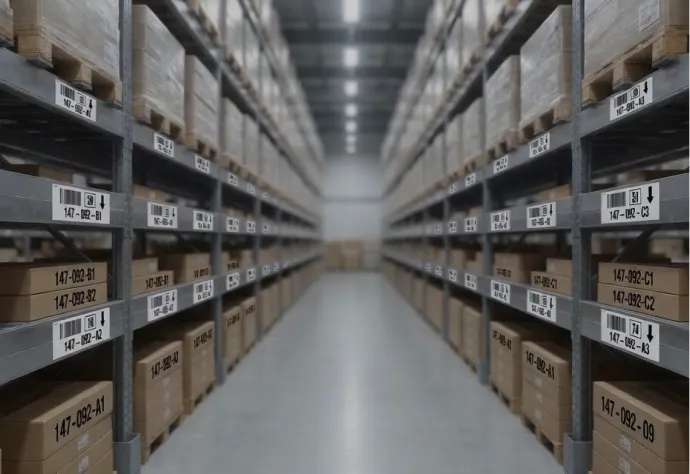
Warehouse barcode labels are identification labels used to mark rack locations, pallet positions, aisles, shelves, doors, bins, and other storage locations throughout a warehouse or distribution center. They help employees and scanning systems accurately identify inventory locations, improving efficiency and reducing errors.
Warehouse barcode labels help organizations:
- Improve inventory accuracy
- Reduce picking and put-away errors
- Speed up receiving and shipping processes
- Improve employee productivity
- Support warehouse management systems (WMS)
- Simplify employee training
- Improve audit and cycle count accuracy
A properly designed labeling system helps ensure that every location can be quickly identified and scanned.
Warehouse barcode labels can include:
- Location numbers
- Barcodes
- QR Codes
- Check digits
- Human-readable text
- Aisle, bay, level, and position information
- Color coding
- Directional arrows
- Company logos
- Custom identifiers
ParCode can customize labels to match your facility’s naming convention and WMS requirements.
Warehouse labels can be produced using a variety of barcode symbologies, including:
- Code 128
- Code 39
- Interleaved 2 of 5
- GS1-128
- QR Codes
- Data Matrix Codes
Our team can recommend the best barcode type based on your scanning equipment and software requirements.
Common warehouse label types include:
- Rack beam labels
- Vertical rack labels
- Upright labels
- Hanging aisle signs
- Floor labels
- Shelf labels
- Pallet position labels
- Freezer-grade labels
- Reflective long-range scan labels
- Dock door labels
- Safety and identification signage
Each solution can be customized to fit your facility and scanning requirements.
Yes. Color coding is often used to help employees quickly identify:
- Product categories
- Warehouse zones
- Temperature-controlled areas
- Pick paths
- Storage areas
- Different departments
Color-coded labels can improve visual recognition and reduce operational errors.
Warehouse barcode labels are available in a variety of durable materials, including:
- Industrial polyester
- Reflective materials
- Freezer-grade materials
- Magnetic labels
- Floor label constructions
- UV-resistant materials
- Chemical-resistant materials
Material selection depends on the environment, scanning distance, and expected lifespan of the label.
Yes. Specialized freezer-grade materials and adhesives are available for cold storage, refrigerated warehouses, and freezer environments. These materials are designed to remain adhered and scannable in low-temperature conditions.
The lifespan of a warehouse barcode label depends on the environment and material selection. High-quality industrial labels can remain legible and scannable for many years, even in demanding warehouse environments that involve forklift traffic, dust, abrasion, and temperature fluctuations.
Yes. ParCode can organize and sequence label data to match your installation flow, making deployment faster and more efficient. Labels can be packaged and supplied in a logical application order to help reduce installation time and minimize errors during implementation.
In most cases, yes. Warehouse barcode labels can be designed to support virtually any Warehouse Management System (WMS), ERP system, or inventory control platform. Our team works with customers to ensure barcode formats, numbering conventions, and label layouts align with system requirements.
Scanning distance depends on barcode size, label design, scanner type, and material selection. Labels can be designed for:
- Close-range handheld scanning
- Forklift-mounted scanners
- Long-range scanning applications
- High-bay warehouse environments
ParCode can recommend barcode sizes and materials based on your specific scanning requirements.
The best warehouse labeling solution depends on:
- Rack configuration
- Scanning equipment
- WMS requirements
- Viewing distance
- Environmental conditions
- Installation method
Our team can help evaluate your facility and recommend the most effective labeling system for your operation.
Whether you’re labeling a new distribution center, expanding an existing warehouse, or replacing damaged labels, ParCode can help design a durable, easy-to-scan labeling system tailored to your operation. With over 40 years of experience and millions of labels produced, we help warehouses improve accuracy, efficiency, and long-term performance.
ParCode manufactures a wide variety of custom warehouse signs, including aisle markers, rack identification signs, dock door signs, overhead hanging signs, safety signage, directional signage, location markers, and barcode-integrated warehouse signs.
Yes. Many of our signs incorporate durable barcode labels, including retro-reflective barcode technology for long-range scanning applications. Signs can include text, barcodes, QR codes, or a combination of all three.
Our signs are typically manufactured from durable industrial-grade plastic substrates designed to withstand warehouse, distribution center, and manufacturing environments while remaining lightweight and highly visible.
Yes. Depending on the application, signs can be suspended from chains, mounted to conduit, attached to wire supports, fastened directly to racks, or installed using custom mounting hardware.
Proper facility identification reduces travel time, minimizes picking errors, improves employee navigation, increases scanning accuracy, and helps maintain organized inventory locations.
The angled design provides an optimal scanning surface for long-range barcode scanners, allowing operators to capture location information quickly and accurately without needing to reposition equipment.
Depending on the scanner and barcode size, retro-reflective barcode placards can often be scanned from distances in excess of 35 feet.
Yes. We can incorporate location numbers, aisle designations, warehouse zones, barcodes, QR codes, and custom graphics on the same placard.
Our team evaluates your warehouse management system, scanner capabilities, mounting requirements, scanning distances, and budget to recommend the most effective solution.
Our floor markers feature a premium 10-mil construction with an ultra-aggressive adhesive, high-quality print substrate, and a premium 3M slip-resistant overlaminate engineered specifically for warehouse environments.
Floor markers are commonly used for warehouse locations, staging areas, inventory zones, pallet positions, safety markings, workstations, and directional guidance.
Our standard floor marker size is 4″ x 6″, but custom sizes are available upon request.
Standard colors include White, Black, Red, Green, Orange, and Blue.
Yes. The pressure-sensitive adhesive backing allows for quick installation without special tools, reducing labor costs and minimizing operational disruption.
Absolutely. Floor markers can be printed with location identifiers, text, barcodes, QR codes, arrows, and other custom information.
Yes. For particularly demanding environments, we offer 32-mil clear PVC protective covers with beveled edges to maximize durability and extend label life.
Service life varies depending on traffic levels and floor conditions, but our floor markers are designed for long-term performance and are trusted in some of the world’s busiest warehouses and distribution centers.
Yes. We can customize the size, color, barcode format, numbering sequence, text layout, and overall design to match your warehouse identification system.
Yes. With over 40 years of barcode identification experience, our team can help develop a complete warehouse location labeling and signage strategy designed to improve efficiency and scanning accuracy.
Yes. We can generate sequential location numbers, corresponding barcodes, check digits, QR codes, and other data formats as required.
Absolutely. We regularly design signage and barcode solutions that integrate with warehouse management systems (WMS), ERP systems, inventory software, and asset management platforms.
The more information you provide, the better we can assist you. Helpful details include:
- Facility layout
- Desired sign or label type
- Dimensions
- Quantity
- Mounting requirements
- Barcode requirements
- Scanner type
- Required scanning distance
Existing numbering scheme
ParCode has been helping companies improve warehouse identification and barcode scanning performance since 1982. We combine durable materials, custom engineering, fast turnaround times, and decades of real-world warehouse experience to deliver solutions that work right the first time.
Asset tags are durable labels used to identify, track, and manage physical assets such as computers, tools, equipment, furniture, vehicles, and machinery. Each tag typically includes a barcode, QR code, serial number, or other unique identifier that links the asset to a database or inventory management system.
Asset tags can be customized to include virtually any information your organization requires, including:
- Company name or logo
- Barcode or QR code
- Sequential asset number
- Serial number
- Department or location information
- Property identification text
- Contact information
- Equipment descriptions
- Security or warranty information
ParCode can customize the layout, colors, and data fields to match your tracking requirements.
Asset tags are available in a variety of materials to suit different environments and applications, including:
- Polyester labels
- Silver polyester labels
- Tamper-evident materials
- Destructible vinyl labels
- High-performance industrial materials
- Outdoor and UV-resistant materials
- Chemical and abrasion-resistant constructions
The best material depends on the asset, environment, and expected lifespan of the tag.
Yes. Some Tamper-evident asset tags are available for organizations that require additional security. These labels are designed to leave a visible pattern (Void),fragment into pieces, or otherwise show evidence of tampering if someone attempts to remove or transfer them.
Absolutely. Asset tags can be produced with QR Codes, Data Matrix Codes, traditional linear barcodes, or multiple barcode formats on the same label. QR codes are especially useful when additional information, maintenance records, or online resources need to be accessed using a smartphone or scanning device.
Asset tags are used across nearly every industry, including:
- Education and School Districts
- Healthcare and Medical Facilities
- Manufacturing
- Government Agencies
- Municipalities
- Warehousing and Distribution
- Information Technology Departments
- Utilities and Telecommunications
- Construction and Field Services
- Corporate Offices and Businesses
Any organization that needs to track valuable equipment can benefit from a well-designed asset tagging system.
The lifespan of an asset tag depends on the material and environment. Standard indoor asset tags often last for many years, while premium industrial constructions can withstand harsh conditions including abrasion, chemicals, UV exposure, moisture, and extreme temperatures.
Par Code offers asset tag materials designed for both short-term applications and long-term asset identification programs that can remain legible and scannable for the life of the asset.
Whether you need simple property labels, tamper-evident security tags, serialized barcode labels, or durable metal asset tags, ParCode can help you select the right material and design for your application. Contact us to discuss your tracking requirements and receive a customized recommendation.
Question not listed here?
Press Releases & Blogs
- Press Release
- Press Release
- Blog
- Blog
- Blog
- Blog
- Blog
